

Symptoms
What Is Vaginal Dryness, and How Do You Actually Fix It?

Zineb Sadki
Editorial writing, Santelle
Vaginal dryness affects far more women than is commonly believed, and at any age.
Discomfort, burning, painful intercourse : these symptoms are real, common, and above all, treatable.
Here is everything you need to know to understand what is happening in your body and to regain lasting intimate comfort.
What is vaginal dryness?
Vaginal dryness is the absence or lack of natural lubrication of the vagina.
It most often results from a drop in oestrogen, the hormones that keep the vaginal mucosa supple, hydrated, and well-supplied with blood.
Without them, the tissues gradually thin, sometimes without the woman making the connection with what is actually happening in her body.
In summary : vaginal dryness occurs when the vaginal mucosa produces fewer natural secretions, due to a drop in oestrogen.
It causes irritation, pain, and increased vulnerability to infections.
It can affect any woman, at any age, for hormonal, medicinal, or psychological reasons.
It is not a sign of ageing; it is a signal that your body is sending you, and it deserves a response.
The symptoms : how to know if you are affected?
Before looking for a solution, one must first recognise the signs.
Vaginal dryness is not just a simple temporary discomfort; it sets in gradually and affects several dimensions of intimate comfort.
Its clinical presentation is quite characteristic, even if some signs are often misinterpreted or wrongly attributed to another cause.
The most common signs are :
redness around the vagina, cervix, and labia
burning and itching sensations
local inflammation
pain during intercourse (dyspareunia, i.e., painful sexual intercourse)
minor bleeding after penetration
recurrent urinary tract infections
This pain sometimes leads to spacing out intercourse, avoiding it, and can gradually erode desire.
When intimacy becomes a source of fear rather than pleasure, it is time to take action.
Confusion with thrush is common, and it is important to know how to distinguish them.
Thrush is accompanied by thick, lumpy white discharge with a characteristic odour.
Dryness, on the other hand, mainly causes a sensation of a lack of lubrication, without abnormal discharge. If in doubt, consult a doctor; the treatments are radically different.

Your profile : why is vaginal dryness happening to you?
Understanding the symptoms is good. Identifying the cause is better.
Vaginal dryness does not have just one face; it can occur at very different times in a woman's life, for hormonal, medicinal, or psychological reasons.
Here are the most common profiles to help you identify where you stand.
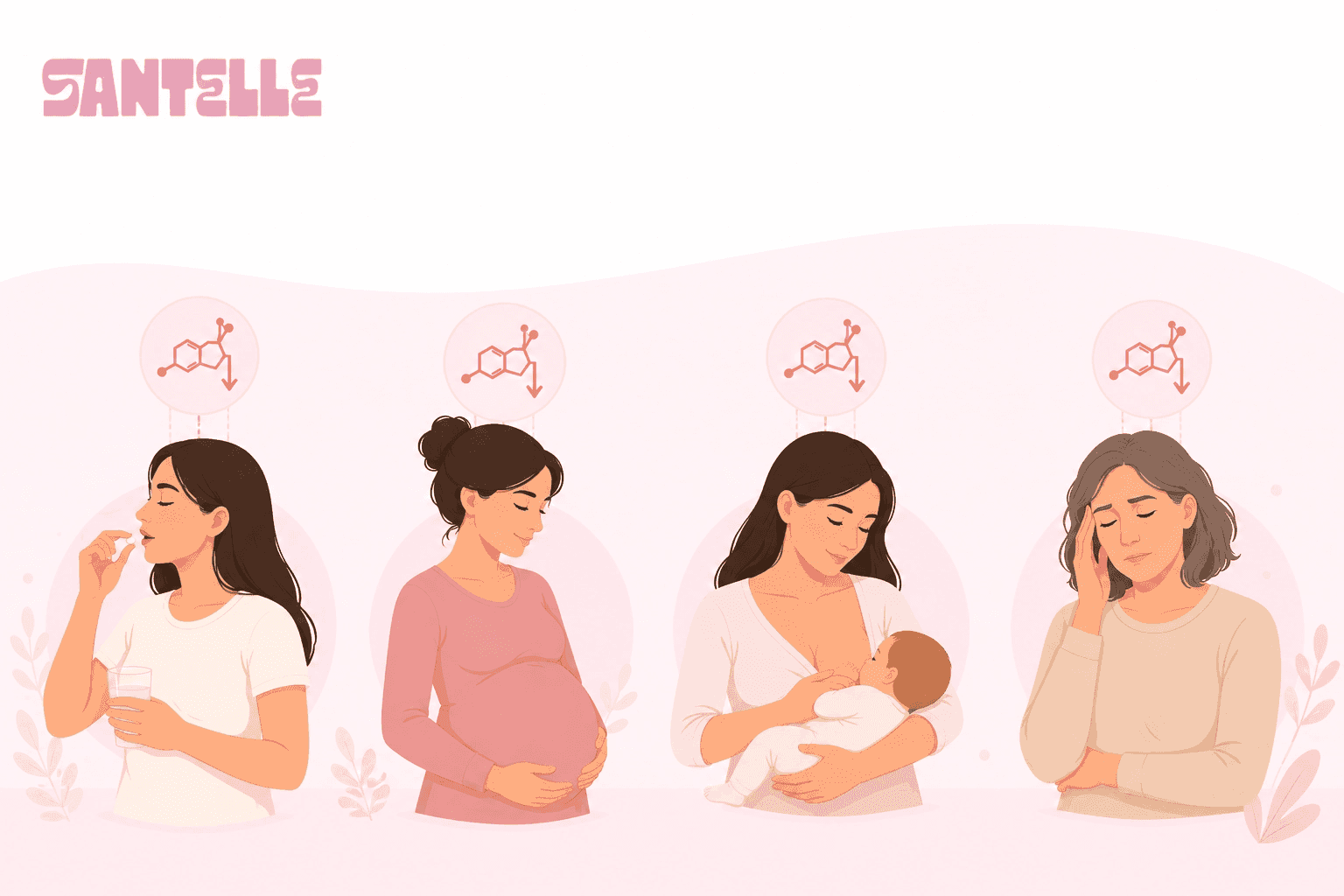
You are in perimenopause or menopause
This is the most common and most under-reported cause.
Menopause causes a sudden drop in oestrogen, which permanently alters the quality of the vaginal mucosa.
This transformation is gradual, often silent at first, and worsens if left untreated.
The drop in oestrogen leads to progressive atrophy (thinning and loss of elasticity) of the vaginal mucosa.
Its cells produce less glycogen—the natural fuel for lactobacillus flora (the good bacteria)—which maintains a protective vaginal pH.
The mucosa then becomes drier, more fragile, and more susceptible to irritation and infections.
Unlike hot flushes, vaginal dryness tends to worsen over time if left untreated.
More than one in two women are affected after the age of 50, yet only a minority bring it up spontaneously with their doctor.
A blood test can measure the level of FSH (follicle-stimulating hormone). A level between 20 and 150 IU/l is characteristic of established menopause. This result points directly towards a local hormonal treatment.
You take the pill or a hormonal contraceptive
Contraception can be the cause, even at age 25.
It is rarely imagined, yet the pill is one of the most common causes of vaginal dryness in young women.
The link between contraception and intimate comfort is still too rarely addressed in consultations.
Certain progestogen-only or low-dose combined pills can lower the local level of oestradiol and cause intimate dryness.
This phenomenon is still too often trivialised or attributed to a lack of desire. You do not have less desire; your body simply lacks local oestrogen.
If you noticed these symptoms after starting or changing your contraception, speak to your doctor.
An adjustment or a change in method may be enough to resolve everything.
You have just given birth or are breastfeeding
Postpartum and vaginal dryness : an almost systematic duo.
After childbirth, the body goes through a very specific hormonal period, dominated by prolactin (the lactation hormone) and marked by an oestrogen level at its lowest.
This context almost inevitably creates intimate dryness, whether you are breastfeeding or not.
Prolactin keeps oestrogen at a very low level to inhibit ovulation. Your body is busy nourishing a life; it has put lubrication on standby, not on permanent pause.
This dryness is biologically normal, but there is no question of waiting and suffering. Solutions exist and are compatible with breastfeeding.
You are going through a period of intense stress
Stress acts directly on intimate lubrication, and it is often the last thing we think of.
When the mind is under pressure, the body feels the effects right down to its intimate sphere. This link between stress and vaginal dryness is physiological, not imaginary.
Cortisol (the stress hormone) disrupts the hypothalamic-pituitary axis—the brain's hormonal regulation system—and imbalances oestrogen production.
Anxiety also inhibits the physical arousal response, mechanically reducing vaginal secretions. It is not "all in your head"; it is a real physiological cascade.
Other causes not to be overlooked
Certain medications and illnesses can also be responsible.
Beyond hormonal and psychological causes, other less-known factors can cause or worsen vaginal dryness. It is important to make the connection with an ongoing treatment or an existing pathology. The most common medicinal causes are :
antidepressants (particularly SSRIs)
antihistamines
certain treatments for high blood pressure
ovulation induction agents
chemotherapy and anti-oestrogens (breast cancers)
ovarian surgery (oophorectomy)
Certain autoimmune diseases, particularly Sjögren's syndrome, can cause widespread mucosal dryness, including vaginal dryness.
On the hygiene side, tight clothing, synthetic underwear, vaginal douching, or soaps with an unsuitable pH can also weaken the vaginal flora.
Treatments for vaginal dryness : choosing what is right for you
Once the cause is identified, it is time to choose the right therapeutic response. There is no single universal treatment; options range from over-the-counter products to hormone treatments prescribed by a doctor.
The key is not to resign yourself : effective answers exist for every profile and every degree of dryness.
Vaginal moisturisers (over the counter)
These are the daily allies of the mucosa, to be strictly distinguished from lubricants.
Many women confuse moisturisers and lubricants, and only use the latter. This is a common mistake that leaves the mucosa without protection on a daily basis.
Unlike lubricants, moisturisers are applied two to three times a week to restore the hydration of the mucosa over time.
The most effective formulas contain hyaluronic acid (Gydrelle, Cicatridine) or polycarbophil (Replens).
They are suitable for all women, regardless of age or cause, and do not require a prescription.
Lubricants for intercourse
They complement moisturisers without replacing them, and their role is often underestimated.
Used alone, lubricants do not treat the underlying dryness, but they remain essential for restoring immediate comfort during intercourse. Well chosen, they can transform the experience.
To be used at the time of intercourse, they immediately relieve friction and significantly reduce pain.
Prefer water-based gels, without perfume or glycerine, compatible with condoms.
Silicone-based lubricants last longer, but are not compatible with silicone accessories.
Local oestrogen creams and pessaries (on prescription)
For menopausal women, this is the reference treatment.
Contrary to received wisdom, local oestrogens do not act like a systemic hormone treatment.
They target the vaginal mucosa directly, with a very low level of general absorption and a reassuring safety profile.
Applied directly into the vagina, they act on the hormonal cause without diffusing massively into the general circulation.
Their safety profile is very favourable, including for women who cannot take systemic hormone therapy.
Within a few weeks, a mucosa damaged by years of deficiency can regain suppleness and vitality.
Hormone replacement therapy (HRT)
A comprehensive option for symptoms that go beyond dryness alone.
When vaginal dryness is just one symptom among others, a comprehensive hormone treatment may prove more suitable than a local solution. This is a decision to be made with your gynaecologist, taking your health profile into account.
When dryness is accompanied by hot flushes, sleep disturbances, or mood swings, HRT may be considered. It is available in oral, patch, or subcutaneous implant form.
It is contraindicated in cases of a history of hormone-dependent cancer.
Natural remedies for vaginal dryness : what science really says
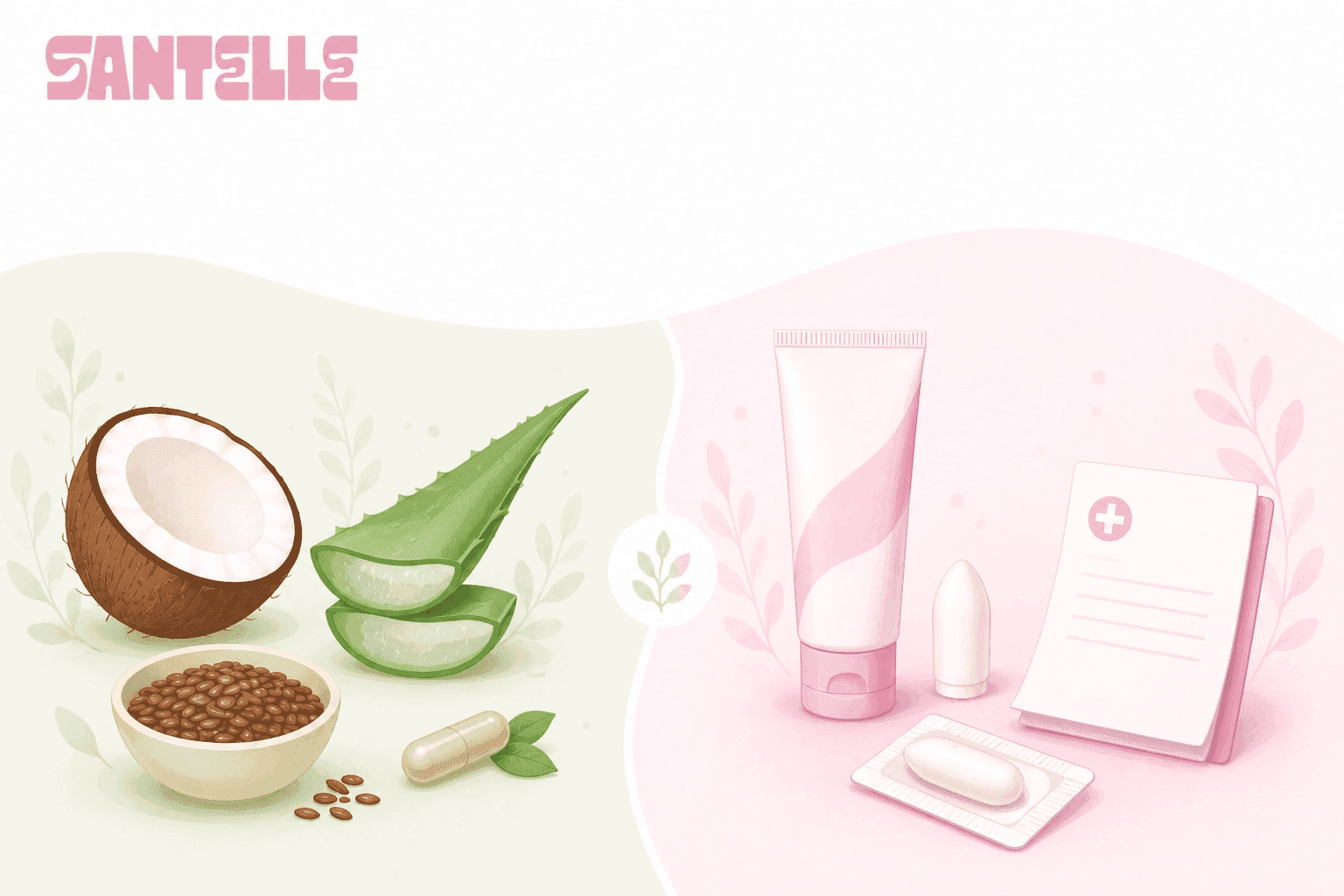
Medical treatments are not the only options; certain natural remedies also have their place. They work better as complements than as substitutes, and their effectiveness varies according to profiles and the severity of the dryness. Before choosing one, it is useful to know what science actually says about the most commonly used ones, without excessive promises or systematic rejection.
1. Virgin coconut oil
Among natural remedies, virgin coconut oil is the one that comes up most often, and for good reason. It combines several interesting properties for the vaginal mucosa : soothing, moisturising, and endowed with mild antifungal and antibacterial properties, it can be used as a lubricant or local moisturiser.
Two important precautions to keep in mind :
it is not compatible with latex condoms
it can unbalance the vaginal flora in some women
Test it gradually.
2. Aloe vera and borage oil
Aloe vera and borage oil act through different mechanisms but complement each other well in a natural approach. They are particularly suitable for women who wish to avoid synthetic products.
Pure aloe vera gel : recognized soothing and moisturising action on irritated mucous membranes
Borage oil (in capsules) : rich in gamma-linolenic acid (GLA), it supports the hydration of mucous membranes from within, particularly during perimenopause
These solutions remain complements, not substitutes for medical treatment if the dryness is severe.
3. Phytoestrogens: soy, red clover
Phytoestrogens have been the subject of numerous studies since the 2000s, with nuanced results.
These plant compounds bind weakly to oestrogen receptors and can provide a real benefit, but they do not replace medical treatment in women with pronounced symptoms.
Their interest is mainly preventive and complementary :
via a diet rich in legumes, flaxseeds, and sesame seeds
in the form of concentrated supplements, only on medical advice
4. Diet, hydration, and lifestyle
We rarely think of diet or hydration when talking about vaginal dryness; yet, what we eat and drink each day directly influences the quality of the mucous membranes.
Good daily habits :
drink 1.5 to 2 litres of water per day
consume omega-3s : oily fish, walnuts, flaxseeds
stop smoking : tobacco directly reduces local blood circulation
pH-neutral soap, no vaginal douching, no perfume on the genital area, cotton underwear
Sex life and vaginal dryness : finding pleasure without the pain
Daily intimate comfort is also, and above all, a question of a serene sex life.
Vaginal dryness should not become a reason to avoid intimacy, either with your partner or with yourself. It requires adapting practices, with kindness and without guilt.
Communication with your partner is just as decisive. Naming what you feel—the discomfort, the pain, the fear that it will hurt—allows you to adapt the pace, positions, and pressure.
Certain positions (woman on top, less deep penetration) are better tolerated in the case of sensitive mucosa.
Regular sexual activity, including masturbation, plays a real preventive role.
It maintains good pelvic blood circulation and preserves the elasticity of the mucosa.
Vaginal dryness can also generate anticipatory anxiety before intercourse.
If this vicious circle sets in, a consultation with a sexologist or a specialised psychologist can be valuable. This comes in addition to, not instead of, medical treatment.
Prevention : the right daily habits
A few simple habits are enough to make a real difference. It is not about transforming your life, but about integrating reflexes consistent with intimate physiology.
Adopted regularly, these habits reduce the risk or limit the worsening of symptoms.
avoid tight clothing and synthetic underwear
use a pH-neutral soap for external intimate washing
do not use vaginal douches
ban perfumes on the genital area
do not smoke
consult without delay as soon as the first symptoms appear
When should you consult a doctor for vaginal dryness?
And if symptoms persist despite these adjustments, it is time to hand over to a professional. Your intimate comfort is a matter of health, not modesty.
Some signs should not wait; they indicate that the situation exceeds what daily care can resolve alone.
Consult your doctor or gynaecologist if :
symptoms persist for more than a few weeks despite moisturisers
intercourse remains systematically painful
you notice redness, bleeding, or recurrent infections
you suspect a link with your contraception or an ongoing treatment
There is no reason to suffer in silence, and a single appointment can change everything.
Frequently asked questions
Is vaginal dryness permanent?
No. In most cases it can be treated effectively. Even with atrophy linked to menopause, a properly followed local treatment can restore a healthy mucous membrane within a few weeks.
Can you have vaginal dryness at 25?
Yes, particularly on certain pills, during periods of intense stress, after giving birth or while breastfeeding. It is not limited to women of a certain age.
How do I know if my vaginal dryness comes from the pill?
If the symptoms appeared or got worse after starting or changing your contraception, the link is likely. See your doctor, a simple change of pill can be enough to resolve it.
Which cream for vaginal dryness without a prescription?
Vaginal moisturisers based on hyaluronic acid (Gydrelle, Cicatridine) or polycarbophil (Replens) are the most effective without a prescription. They are used 2 to 3 times a week, independently of sex.
Are vaginal moisturisers reimbursed?
Prescription local oestrogen creams are reimbursed in France. Over-the-counter moisturisers (Replens, Gydrelle) generally are not, but remain available in pharmacies without a prescription.
Can vaginal dryness cause infections?
Yes. A weakened mucous membrane is less well protected against pathogens. Recurrent urinary and vaginal infections are often an indirect signal of untreated vaginal dryness.
Written by
Zineb Sadki
Editorial writing, Santelle
Zineb is a writer at Santelle and covers intimate health and the vaginal microbiome.