

Symptoms
Vaginal cysts: types, symptoms, causes, and treatment

Zineb Sadki
Editorial writing, Santelle
Have you noticed a lump in your vagina or a bump near the opening of your vagina while washing, wiping, or during sex?
Or perhaps you recently had a gynecological exam and were diagnosed with a Bartholin's, Gartner's, or Müllerian cyst, and want to learn more about it?
In the vast majority of cases, a vaginal cyst is non-cancerous (benign) and harmless.
Here is everything you need to know about the symptoms of vaginal cysts, their causes, how they are diagnosed, and how they are treated.
What is a vaginal cyst?
A vaginal cyst is a small pocket filled with fluid, sometimes oily substance (sebum), or pus if it becomes infected. These cysts can form in the wall of the vagina, near the vaginal opening (on the vulva), or in the surrounding tissues.
The vast majority of these cysts are harmless, non-cancerous, and not contagious. They do not always require treatment, and most of the time, they are completely unrelated to cancer or sexually transmitted infections (STIs).
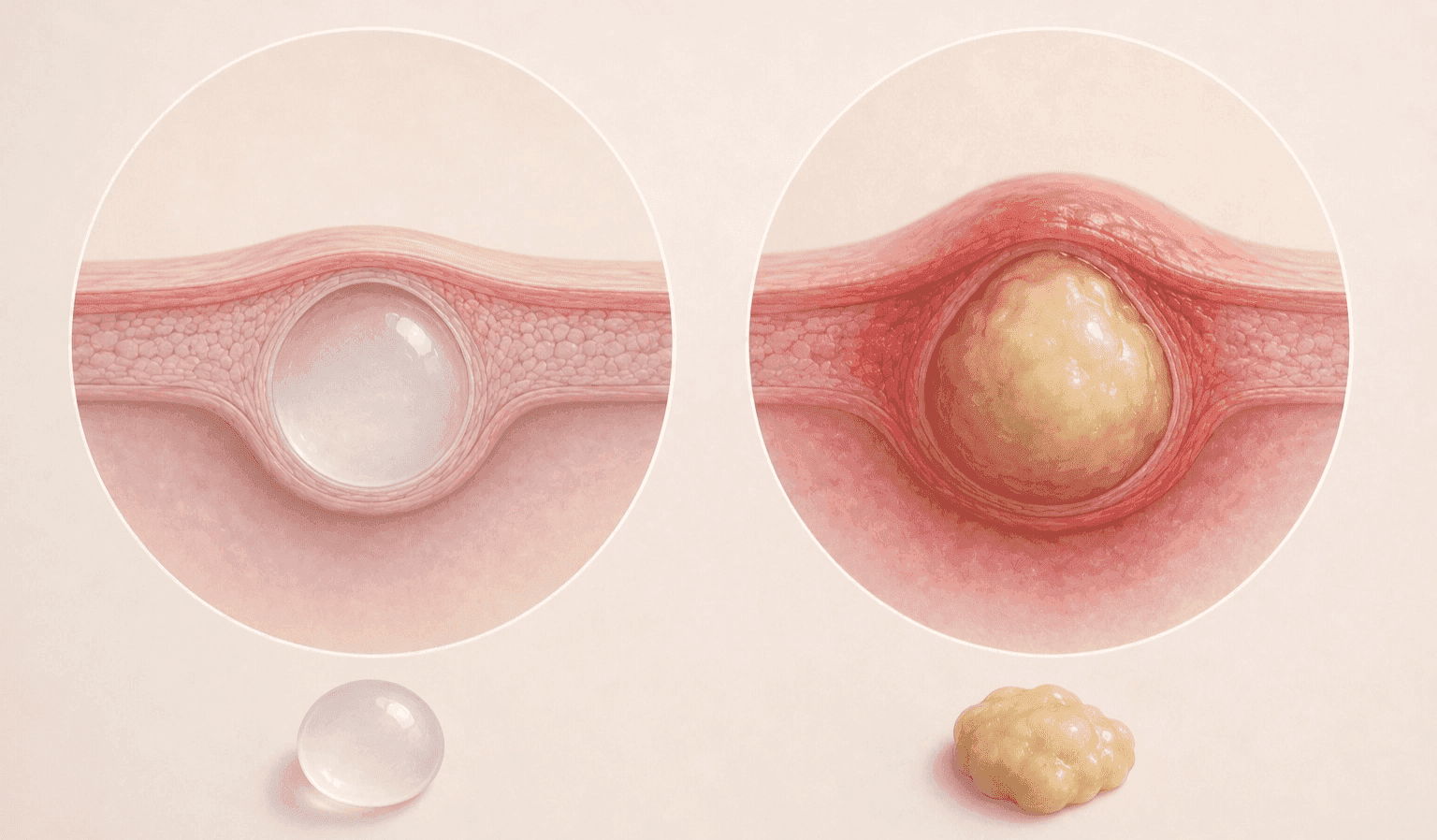
Cyst vs. Abscess: What is the difference?
It is easy to confuse the two, but the difference is simple:
A cyst is a firm, usually painless lump under the skin.
An abscess is a soft pocket filled with pus. It is often painful, warm to the touch, and swollen. It is a sign of an active infection and needs prompt medical attention.
A cyst can turn into an abscess if it gets infected. This is common with Bartholin's cysts, which can lead to a condition called bartholinitis.
People often wonder, "Is it a vaginal cyst or an abscess?" If you are unsure, a quick exam by a healthcare provider is the best way to find out.
Vaginal cysts and cancer: Should you worry?
Discovering a lump in such a sensitive area can easily cause worry.
Rest assured: a vaginal cyst is almost never a sign of cancer. Bartholin's, Gartner's, Müllerian, sebaceous, and inclusion cysts are all harmless, non-cancerous growths.
While tumors of the Bartholin's gland can happen, they are extremely rare and typically affect women over the age of 40 or 50. This is different from typical Bartholin's cysts, which are much more common in younger women.
If there is any doubt (for example, if the lump is hard, grows quickly, or appears after age 40), your gynecologist may suggest a small tissue sample (biopsy) to be absolutely sure.

What are the different types of vaginal cysts?
There are several types of vaginal cysts, categorized by where they form and how they develop.
Bartholin's cyst
This is the most common type. The Bartholin's glands, located on both sides of the vaginal opening, normally produce fluid to help with lubrication.
If the opening of one of these glands gets blocked, the fluid builds up and forms a cyst. These are most common in women in their 20s and 30s.
Gartner's duct cyst
This type forms from a tiny remnant of a duct (the Gartner's duct) that normally disappears before birth. These cysts typically develop on the side walls of the vagina.
Müllerian cyst
This cyst develops from leftover cells from the Müllerian ducts, structures present during early fetal development. They are usually discovered by chance during a routine pelvic exam.
Sebaceous (epidermoid) cyst
These occur when a hair follicle or oil gland becomes blocked, often on the outer lips of the vagina (vulva).
These look and feel just like the clogged pore bumps or sebaceous cysts you might get elsewhere on your body.
Inclusion cyst
This type usually forms after an injury to the vaginal wall—such as during childbirth, an episiotomy, or surgery—where skin cells accidentally get trapped beneath the surface.
What are the symptoms of a vaginal cyst?
Most of the time, small vaginal cysts do not cause any symptoms and are only found during a routine exam or while washing.
When symptoms do happen, they may include:
A noticeable lump near the opening or on the wall of the vagina
Discomfort or pain during sex
Discomfort when sitting or walking
Difficulty or mild pain when inserting a tampon
A painful vaginal cyst is a sign to pay attention to: pain usually means the cyst has become infected or has grown large enough to press on nearby tissues.
If an infection develops (creating an abscess, or bartholinitis in the case of a Bartholin's gland), symptoms will be more obvious:
Significant pain
Visible swelling
Warmth in the area
Fever
Pus-like drainage
If you experience these symptoms, you should see a doctor promptly.
Vaginal cysts during pregnancy: Should you worry?
Finding a lump—especially a Bartholin's cyst—during pregnancy can be worrying, but it is generally nothing to fear.
A Bartholin's cyst found during pregnancy is usually harmless and will not affect your health or your baby's development.
However, if the cyst becomes infected during pregnancy, it is important to see a doctor quickly. Untreated infections in the pelvic area should be addressed promptly to protect your pregnancy.
As for childbirth, a small, simple cyst usually will not get in the way of a vaginal delivery. If the cyst is very large or might block the birth canal, your midwife or doctor will discuss the best plan for you.
How is a vaginal cyst diagnosed?
Diagnosis usually involves:
A physical pelvic exam. This is the first step and is often all that is needed to identify a cyst.
Imaging tests if necessary, such as an ultrasound, MRI, or CT scan, to get a clearer look at the exact location and size of the cyst.
A swab or test to check for any underlying sexually transmitted infections.
A biopsy (tissue sample) in rare cases if there is any uncertainty about the growth, to ensure it is completely benign.

How are vaginal cysts treated?
The treatment for a Bartholin's cyst (the most common type) is similar to how most symptomatic vaginal cysts are managed. Treatment depends on how big the cyst is, whether it causes discomfort, and if it is infected.
Watchful waiting
Most small cysts that do not cause any discomfort do not need treatment. Your doctor will simply keep an eye on them during your regular checkups.
Medical treatment
If there is an infection or a confirmed STI, your doctor will prescribe antibiotics along with pain relievers to help you feel more comfortable.
Drainage or simple incision
This is often the first step for an infected abscess. It provides quick relief, but the downside is that cysts often return after simple drainage because the small opening heals and closes up quickly.
Word catheter
This is a tiny, temporary balloon catheter placed inside the cyst for 4 to 6 weeks.
It keeps the gland open so it can heal from the inside out, which greatly reduces the chance of the cyst returning.
Marsupialization
In this minor procedure, the doctor creates a small opening in the cyst and stitches the edges open so it can drain freely and continuously.
This is highly effective for Bartholin's cysts that keep coming back. It is a quick, minimally invasive procedure that is usually done as an outpatient visit.
FAQ: Frequently asked questions about vaginal cysts
Is a vaginal cyst dangerous?
No, in almost all cases. Vaginal cysts are non-cancerous and not contagious. However, it is always a good idea to have a doctor check any new lump to confirm what it is and rule out infection.
Can a vaginal cyst go away on its own?
Yes, some small cysts that do not cause symptoms can shrink and disappear on their own, or they may remain the same size without ever causing trouble.
When should I see a doctor urgently?
If you experience severe pain, rapid swelling, a fever, or pus draining from the lump, seek medical care quickly. These are signs of an infection (abscess) that needs to be drained.
Can a vaginal cyst come back after treatment?
Yes, they can return, especially if they were only drained with a simple incision. Procedures like a Word catheter or marsupialization lower this risk, with recurrence rates estimated at only 7% to 9%.
Are Bartholin's cysts caused by STIs?
Not typically. They are usually caused by a simple blockage of the gland's opening, without any infection. However, your doctor may run a quick test just to rule out an STI if you have symptoms of infection.
Can a vaginal cyst be cancer?
This is extremely rare. Vaginal cysts are almost always benign (non-cancerous). A growth that is hard, grows very quickly, or appears after age 40 to 50 is the main reason a doctor would perform additional tests to be safe.
Why is my vaginal cyst painful?
Pain usually means the cyst has become infected (forming an abscess) or has grown large enough to press on nearby nerves and tissues. In either case, seeing a healthcare provider can help you get quick relief.
Frequently asked questions
Is a vaginal cyst dangerous?
No, in the vast majority of cases. A vaginal cyst is benign and not contagious. A consultation is still recommended to confirm the diagnosis and rule out an infection.
Can a vaginal cyst disappear on its own?
Yes, some small asymptomatic cysts can resolve spontaneously or stay stable without ever needing intervention.
When should you seek urgent advice?
With intense pain, rapid swelling, fever or a discharge of pus, it is advisable to seek advice quickly, as this can signal an abscess that needs draining.
Can a vaginal cyst come back after treatment?
Yes, it is possible, particularly after a simple incision. Techniques such as the Word catheter or marsupialisation limit this risk, with a recurrence rate estimated at between 7 and 9%.
Is a Bartholin's cyst linked to an STI?
Not systematically. It most often results from a blockage of the gland's duct, with no particular infectious cause. A swab can still be taken to rule out an STI if there is any doubt.
Can a vaginal cyst be cancer?
This is very rare. A vaginal cyst is almost always benign. Only a lesion that grows quickly, becomes hard, or appears after the age of 40 to 50 may justify further examination to rule out a tumour.
Why is my vaginal cyst painful?
A painful vaginal cyst is generally a sign that it has become infected (forming an abscess) or that it has grown large enough to press on nearby tissue. In both cases, a consultation will relieve the pain quickly.
Written by
Zineb Sadki
Editorial writing, Santelle
Zineb is a writer at Santelle and covers intimate health and the vaginal microbiome.