

Tests and diagnosis
Which vaginal test to choose without a prescription in Switzerland?

Yasmina Akni
SEO and press relations, Santelle
Vaginal health is still a taboo subject, even though itching, burning, unusual discharge or changes in odour are common.
An autotest can help you better understand these symptoms and find out if it is useful to consult a doctor.
In Switzerland, it is possible to buy a vaginal test over-the-counter, at a pharmacy or online.
However, not all of them measure the same thing. Some only analyse vaginal pH, while others assess several biomarkers to provide more information on vaginal balance and track its evolution over time.
Warning:
An autotest remains an orientation tool. It can help you better understand certain symptoms or changes, but does not replace the advice of a healthcare professional when a diagnosis or treatment is necessary.

Can you buy a vaginal test over-the-counter in Switzerland?
Yes. Several vaginal autotests are available without a prescription in Switzerland, particularly in pharmacies and from certain online pharmacies.
They allow you to get an initial indication without having to book an appointment with a doctor immediately.
This can be useful when symptoms are mild, difficult to interpret or if you simply want to check your vaginal balance.
How to ask for Santelle in a pharmacy?
Santelle is available in selected Amavita, Coop Vitality and Sun Store pharmacies as part of Consultation Plus.
Find a participating pharmacy
Check the list of pharmacies offering Santelle near you.Ask the pharmacist for Santelle
The test is not necessarily on display on the shelves. Ask the pharmacy team directly.Perform the test with guidance
You can discuss your symptoms in a confidential area, take the test on site and be guided in understanding your results.

Santelle is one of the tests offered in selected participating Amavita, Coop Vitality and Sun Store pharmacies, allowing you to carry out the test with support if needed.
This option can be interesting for those who want an initial orientation without going directly through a medical consultation.
What types of vaginal tests are available over-the-counter?
In Switzerland, there are mainly two types of vaginal autotests: pH tests and tests that analyse multiple biomarkers.
They do not give the same level of information about vaginal balance.
Tests that analyse multiple biomarkers
Some autotests are not limited to pH and analyse several indicators from a single vaginal swab.
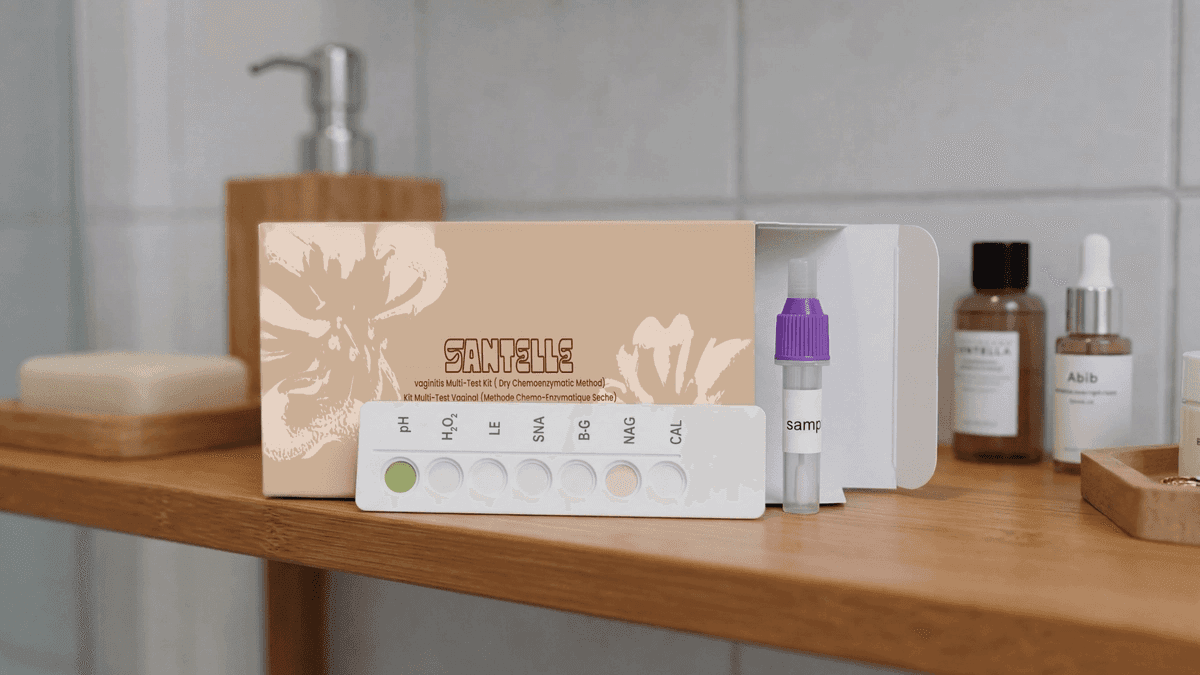
This is the case with Santelle, which analyses six complementary biomarkers:
pH, which measures vaginal acidity.
Hydrogen peroxide (H₂O₂). A low level may indicate that this protective flora is less present.
Leukocyte esterase (LE), which indicates the presence of white blood cells and can signal inflammation or infection;
Sialidase (SNA), an enzyme associated with certain bacteria involved in bacterial vaginosis.
Beta-glucuronidase (β-G), a marker associated with bacterial imbalances, particularly aerobic vaginitis.
N-acetyl-glucosaminidase (NAG), an enzyme associated with the presence of fungi and which can point towards a vaginal yeast infection.
Together, they provide information on different aspects of vaginal balance, such as acidity, the presence of protective bacteria or certain signs associated with inflammation or imbalance.
This analysis particularly helps to guide you towards a yeast infection, bacterial vaginosis or another vaginal imbalance, rather than relying solely on a change in pH.
The test is performed from a single swab and results are available after about 10 minutes.
The Santelle app guides the test, helps interpret the six biomarkers and saves the results so you can track the evolution of your vaginal balance over time.
This tracking can be particularly useful when symptoms return regularly or when you simply want to get to know your vaginal balance better.
A multi-biomarker test, however, remains an orientation tool and not a medical diagnosis.
Vaginal pH tests
Most simple vaginal autotests available in pharmacies are based on measuring vaginal pH.
The vagina naturally has an acidic environment.
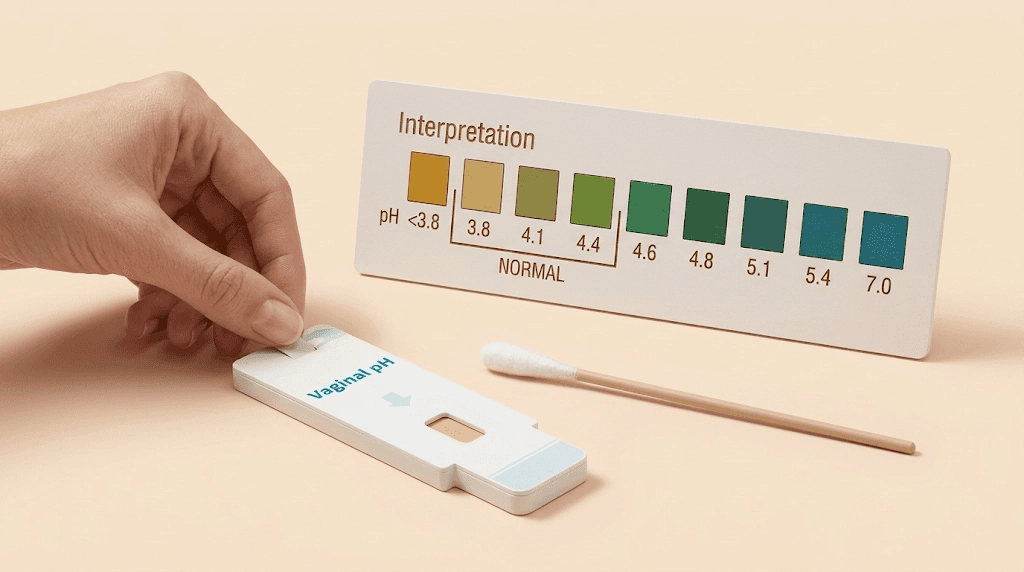
When this balance changes, the pH can increase. A pH test generally involves putting a strip or applicator in contact with vaginal secretions, then comparing the resulting color with a scale.
In practice, the result mainly indicates whether your pH is within the expected range or if it is higher.
For example:
a normal vaginal pH does not rule out a yeast infection, as thrush can occur without significantly changing the pH;
a higher pH can be observed in the presence of bacterial vaginosis, but also in other situations.
Tests available in Swiss pharmacies, such as the Biosynex vaginal autotest, use this method to orient between different possible causes based on vaginal pH.
To choose a test, it is therefore useful to look not only at where it is sold or its price, but especially at what it actually measures and the type of result it can provide.
Vaginal pH test | Santelle test |
|---|---|
Analysis: vaginal pH | Analysis: six biomarkers, including pH |
Result: indicates if pH is within the expected range or if it is high | Result: gives a more complete view of vaginal balance |
Utility: detect a change in pH | Utility: better differentiate between several possible causes of similar symptoms |
Tracking: generally no | Tracking: results saved in the app |
Limitation: does not allow precise identification of the cause | Limitation: does not replace a medical diagnosis |
What can a vaginal autotest tell you?
A vaginal test can give information on the balance of the vaginal microbiome and help understand the possible origin of certain symptoms.
However, what it indicates depends on the elements it analyses.
What a vaginal test can tell you
A test based solely on pH mostly helps to know if the vaginal environment maintains its usual acidity or if it has changed.
A test that analyses multiple biomarkers can provide indications on:
The balance of the vaginal microbiome: pH and H₂O₂ levels provide information about the vaginal environment and the presence of lactobacilli, the bacteria that naturally help protect the vagina.
Bacterial vaginosis: a higher pH associated with certain markers, notably sialidase, can point towards a bacterial imbalance characteristic of vaginosis.
Vaginal yeast infection (thrush): N-acetyl-glucosaminidase (NAG) is associated with the presence of fungi and can point towards a yeast infection, such as vaginal candidiasis.
Aerobic vaginitis or other bacterial imbalance: beta-glucuronidase can provide an indication of certain imbalances related to aerobic bacteria.
Inflammation: leukocyte esterase reveals the presence of white blood cells, which can be a sign of inflammation or infection.
This information can be particularly useful when symptoms like itching, burning, unusual discharge or changes in odour could have several causes.
Indeed, the symptoms of a yeast infection, bacterial vaginosis or other imbalances can look very similar.
However, an important distinction must be made: a multi-biomarker autotest does not give the complete composition of your vaginal microbiome.
It provides indicators on its balance and on certain changes that may suggest a yeast infection, bacterial vaginosis or other imbalance.
A laboratory analysis is necessary to precisely identify the microorganisms present.
What a vaginal test cannot tell you
A vaginal autotest does not allow for all diagnoses.
In particular, it should not be considered a general screening for sexually transmitted infections (STIs).
Chlamydia, gonorrhoea, HIV or syphilis, for example, require tests specifically designed to screen for these infections.
It is best to seek advice from a healthcare professional when:
symptoms are severe or painful;
they persist or return regularly;
you have a fever, pelvic pain or unusual bleeding;
you are pregnant;
you think you may have been exposed to an STI;
you are unsure about the interpretation of the result;
symptoms continue despite treatment.
The goal of an autotest is therefore primarily to better understand what is happening and to know what step to consider next, rather than to replace a medical consultation.
Frequently asked questions
Can a yeast infection or bacterial vaginosis be treated with an over-the-counter cream?
A yeast infection and bacterial vaginosis are two different problems and are not treated in the same way. A yeast infection is generally linked to the overgrowth of a yeast, whereas bacterial vaginosis corresponds to an imbalance in the bacteria present in the vagina. A treatment intended for a yeast infection will therefore not necessarily be suitable for vaginosis. Some antifungal treatments for yeast infections are available directly in pharmacies, but it is better to confirm the cause of the symptoms before starting a treatment, particularly if it is a first episode or if the symptoms come back regularly.
Which over-the-counter treatment for a yeast infection can be used during pregnancy?
During pregnancy, it is better not to start a treatment for a yeast infection on your own, even when a product is available without a prescription. Itching or unusual discharge is not always caused by a yeast infection, and some treatments are not suitable for every situation. Ask your pharmacist, midwife or doctor for advice before using a vaginal treatment during pregnancy.
Which cream can be used without a prescription for intimate itching?
The choice depends above all on the cause of the itching. Irritation, a yeast infection, vaginosis or a reaction to a product can cause fairly similar sensations. A cream intended to relieve the symptoms therefore does not necessarily treat their origin. If the cause is not clear, a vaginal test can provide a first indication. If the itching is severe, persists, comes back frequently or is accompanied by other symptoms, it is better to ask a healthcare professional for advice before using a treatment.
Which vaginal tests can you buy without a prescription in Switzerland?
You will mainly find **vaginal pH tests and tests analysing several biomarkers**. pH tests indicate whether vaginal acidity is within the expected range or whether the pH is elevated. They can provide a first piece of information, but on their own they cannot precisely identify the cause of a symptom. Santelle makes it possible to obtain more information about vaginal balance and to track results over time. The test can be done at home or in certain participating pharmacies in Switzerland.
Can a vaginal test bought without a prescription screen for an STI?
No. A self-test designed to analyse vaginal balance is not automatically an STI screening test. Each sexually transmitted infection requires a suitable test. If you think you have been exposed to an STI, it is better to use a screening test specifically designed for that purpose or to contact a healthcare professional.
Do you need symptoms to take a vaginal test?
Not necessarily. A test can be taken when symptoms appear, but it can also be used to get to know your vaginal balance better or to observe how it changes over time. This tracking option is particularly useful with a test like Santelle, since the results can be kept in the app. A self-test does not, however, replace the examinations or screenings recommended by your doctor or your gynaecologist.
Written by
Yasmina Akni
SEO and press relations, Santelle
Yasmina is an SEO specialist at Santelle, with a degree in biotechnology for health.