
Tests and diagnosis
The best at-home vaginal balance screening test

Roxanne Sabbag
Co-founder and biomedical engineer, Santelle
When I had my first vaginal infection, I went to the pharmacy, bought a pH strip, and it gave me a number. Just one. It didn't tell me what I had, or what to do next.
Santelle was born out of this frustration. In this article, I will explain to you what our test really measures, biomarker by biomarker, why we analyse six rather than one, and how Santelle compares to other available tests.
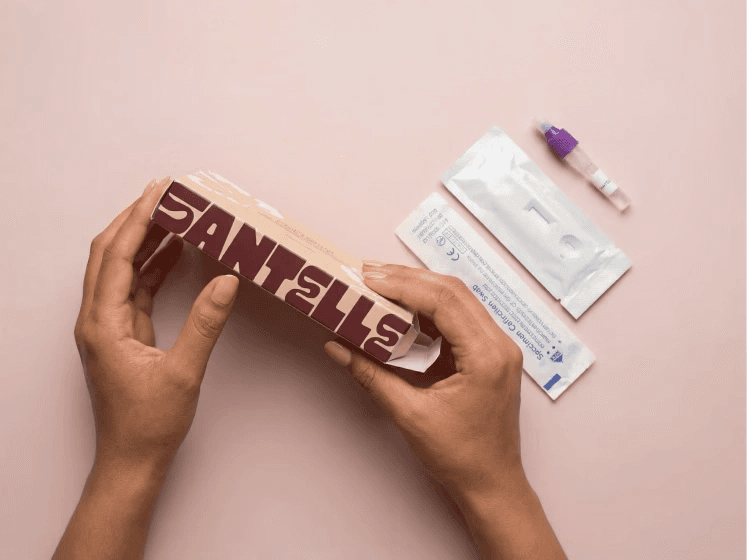
What makes the Santelle test different from other vaginal self-tests?
The enzymatic biomarkers used by Santelle are already used in professional vaginal tests.
Our work was to bring them together in a format that can be used at home, with guided reading.
6 biomarkers analysed from a single sample, whereas most vaginal self-tests in pharmacies only measure pH.
Around 10 minutes, at home, without sending to the laboratory or waiting for several days.
Clear guidance: thrush, bacterial imbalance, inflammation or balanced flora, with the app that helps you read your results and tells you if you can act on your own or if it is better to consult a doctor.
A CE-certified in vitro diagnostic medical device (IVDR), overseen by a scientific committee of four women's health specialists.
Is the Santelle test reliable and clinically validated?
The enzymatic biomarkers used by Santelle are already used in professional vaginal tests.
Our work was to bring them together in a format that can be used at home, with guided reading.
CE-certified test according to the European IVDR regulation, the framework governing in vitro diagnostic medical devices.
Evaluated with over 2,000 women in Europe
A scientific committee that validates our biomarkers and our content: Dr Regula Bürki (gynaecologist, Switzerland), Dr Sam Campbell (molecular biologist, UK), Dr Tommaso Busolo (vaginal health expert, Italy) and Dr Tihesia Riley (sexual health physician, Canada).
Are vaginal pH tests reliable?
Vaginal pH is the level of acidity in your vaginal environment.
A balanced flora, dominated by lactobacilli, is naturally acidic: around 3.8 to 4.5.
It is a useful indicator. But it has two major limitations.
A high pH can have several causes. Bacterial vaginosis, trichomoniasis, aerobic vaginitis, but also simply periods or recent intercourse: blood and semen make the pH rise.
A normal pH does not mean everything is fine. Thrush, for example, is generally accompanied by a normal pH.
This is indeed the logic of the strips: high pH, we think of a bacterial cause; normal pH, we "assume" thrush. An assumption, not an indication.
This is exactly where I wanted to go further. Instead of deducing, measuring what microorganisms and your body are actually producing.
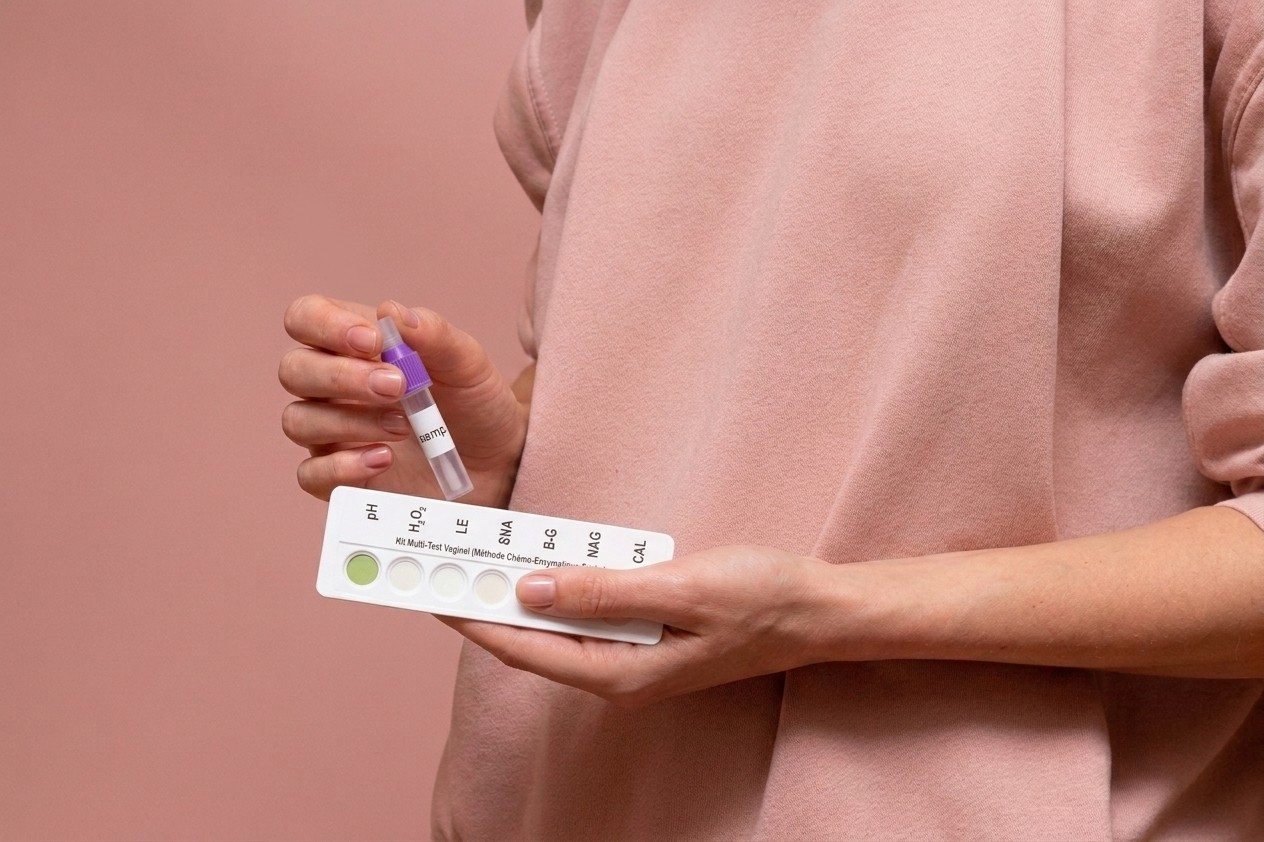
What are the 6 biomarkers analysed by the Santelle test?
A biomarker is a measurable substance that provides information about what is happening in your body.
Some of those measured by Santelle are enzymes produced by bacteria or yeasts, others reflect your body's reaction.
What does vaginal pH measure, and what is a normal pH?
What it measures: the acidity of the vaginal environment.
Why it's useful: it's the starting point. A pH rising above 4.5 signals that protective lactobacilli are losing ground.
What it doesn't tell you on its own: the cause of this change.
What is the purpose of hydrogen peroxide (H₂O₂) in the vaginal flora?
What it measures: a substance produced by certain species of lactobacilli, the "good" bacteria in your flora.
Why it's useful: it's a marker of your protective flora. If it's present, that's a rather good sign. If it's absent, it can indicate that protective lactobacilli are becoming scarcer, a typical scenario of vaginosis.
This is the only "positive" marker in the panel: it doesn't look for a problem, it checks that your defences are in place.
What does a positive leukocyte esterase mean?
What it measures: an enzyme released by white blood cells.
Why it's useful: its presence signals an inflammatory reaction, in other words that your body is defending itself against something. It is found in particular in cases of aerobic vaginitis, trichomoniasis or thrush.
A detail that changes everything: bacterial vaginosis, on the other hand, generally causes little inflammation. This marker therefore also helps to distinguish between situations.
What is sialidase, and why does it point towards vaginosis?
What it measures: an enzyme produced by several bacteria involved in bacterial vaginosis, such as Gardnerella or Prevotella.
Why it's useful: it is one of the most studied markers of bacterial vaginosis, already used in professional tests. Where pH says "something is wrong", sialidase helps to say "and it's rather bacterial".
What does β-glucuronidase correspond to in a vaginal test?
What it measures: an enzyme produced by so-called aerobic bacteria, such as E. coli or Group B Streptococcus.
Why it's useful: it points towards aerobic vaginitis, an infection less known than vaginosis but which is often confused with it. The two are not treated in the same way, and a pH strip cannot tell them apart.
Does N-acetylglucosaminidase (NAG) make it possible to identify thrush?
What it measures: an enzyme produced in particular by yeasts of the genus Candida.
Why it's useful: it is the marker that points towards vaginal thrush. It is the one that replaces the simple assumption "normal pH = thrush" with a real measurement.
What does each biomarker reveal, in brief?
Biomarker | What it reflects | It points rather towards |
|---|---|---|
pH | Acidity of the vaginal environment | An imbalance of the flora (if high) |
H₂O₂ | Presence of protective lactobacilli | A protective flora in place (if present) |
Leukocyte esterase | White blood cells, inflammation | An inflammatory infection |
Sialidase | Bacteriosis bacteria | Bacterial vaginosis |
β-glucuronidase | Aerobic bacteria | Aerobic vaginitis |
NAG | Yeasts (Candida) | Vaginal thrush |
How to know if it is thrush, vaginosis or aerobic vaginitis?
An isolated marker can be misleading; it is the combination that gives a reliable orientation. A few examples of profiles:
high pH + positive sialidase + absent H₂O₂ + little inflammation: a profile suggestive of bacterial vaginosis.
normal pH + positive NAG + inflammation: a profile suggestive of thrush.
high pH + positive β-glucuronidase + marked inflammation: a profile suggestive of aerobic vaginitis.
normal pH + present H₂O₂ + no other marker: a balanced flora.
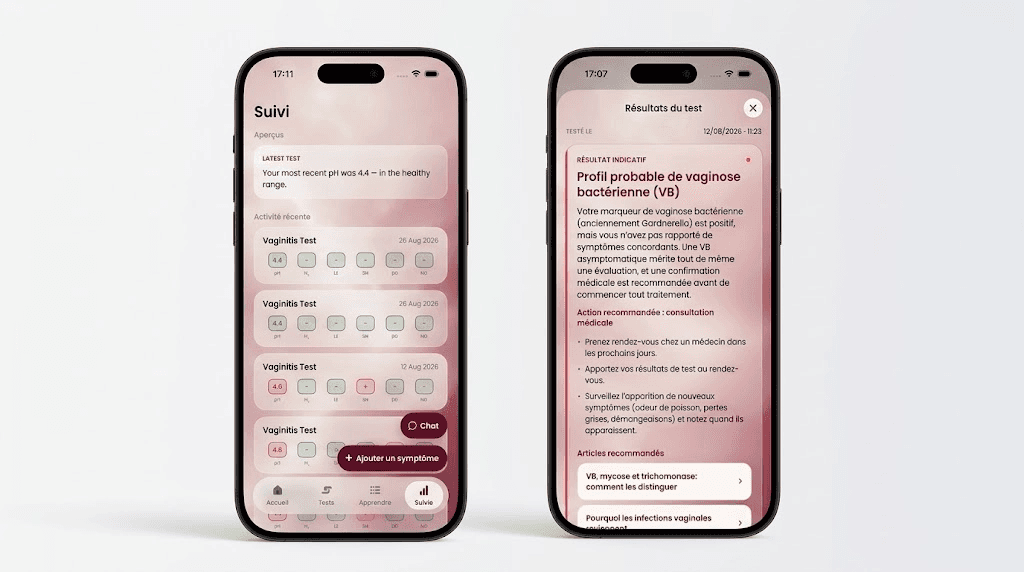
You don't have to do this reading yourself: the Santelle application interprets the six results together and suggests the most appropriate next step for you. But I like you to know what is behind it.

Which vaginal self-test to choose: pH, antigens, sequencing or Santelle?
When looking to understand what is happening, we now have five major options. Each has its place.
Type of test | What it measures, in how long | What it allows, and its limitation |
|---|---|---|
pH strip | pH alone, in a few seconds, for a few pounds | Spotting an abnormal pH, without distinguishing the cause |
"3 in 1" antigen test | 3 microorganisms (Candida, Gardnerella, Trichomonas), in a few minutes | Targeting 3 germs, without saying anything about the protective flora or inflammation |
Santelle self-test | 6 biomarkers including pH, in about 10 minutes | Pointing towards a probable cause and the right course of action; does not replace a medical diagnosis |
Microbiota analysis in laboratory | Bacterial composition by DNA sequencing, in a few days to 2 weeks, often £150 to £300 | Mapping the flora in detail, but too slow when faced with a symptom |
Consultation with sampling | Clinical examination and analyses, depending on the appointment | Making a diagnosis and prescribing, with an access time that can sometimes be long |
Is Santelle more comprehensive than a pH strip?
This is the most direct comparison, since these are the self-tests most easily found in pharmacies.
They are simple, fast and cheap. But they only measure one thing, and they leave thrush as an assumption.
Santelle measures pH too, then goes five markers further.
And what about the "3 in 1" self-tests that detect antigens?
We also find, especially online, tests that look for specific proteins of Candida, Gardnerella and Trichomonas.
They target three specific germs, but tell you nothing about your protective flora or any potential inflammation.
Santelle looks both at what imbalances the flora and what protects it, and also identifies aerobic vaginitis, which these tests do not target.
Should you rather do a vaginal microbiome test in a laboratory?
These analyses, offered by laboratories or brands like Evvy in the United States, identify hundreds of species of bacteria and yeasts.
This is fascinating for research or in-depth monitoring, particularly in fertility journeys. But you have to send the sample and wait several days.
When it itches tonight, you need an answer tonight. That is the moment Santelle was designed for.
Does a vaginal self-test replace a consultation?
Santelle does not replace it, and does not try to do so. It helps you know if you need to consult, and to arrive at your doctor's or pharmacist's with concrete elements rather than with an "I don't really know".
Frequently asked questions
What is the best test to check your vaginal balance at home?
A multi-biomarker self-test. A single strip only measures pH, which indicates an imbalance without giving the cause. Santelle analyses six markers in 10 minutes and points towards thrush, bacterial vaginosis, aerobic vaginitis or a balanced flora.
Is Santelle more reliable than a pH test?
It is more informative. A high pH can be caused by vaginosis, trichomoniasis, menstruation or a recent sexual encounter, and a normal pH does not rule out a yeast infection. Santelle adds five markers to identify the probable origin. It guides you, but does not provide a medical diagnosis.
Is it necessary to send a sample to the laboratory?
No. Sample collection, analysis, and reading are all done at home in about 10 minutes, with no sending or appointment required.
Can you take the test without symptoms?
Yes, and that's actually one of the reasons why I created Santelle.
We track our sleep, our steps, our cycle. But we often only pay attention to our vaginal health when something goes wrong. Yet, knowing your intimate balance when everything is fine gives you a reference point for the future.
Doing the test without symptoms is useful to:
know your vaginal health, simply to better understand your body;
spot a silent imbalance: bacterial vaginosis, for example, often goes unnoticed;
check that everything has returned to normal after an infection or antibiotic treatment;
take care of your flora if you suffer from recurrent infections or if you are planning a pregnancy.
Because knowing yourself better shouldn't wait until you have a problem.
Written by
Roxanne Sabbag
Co-founder and biomedical engineer, Santelle
Roxanne co-founded Santelle and is a biomedical engineer specialising in vaginal health.