

Yeast infections
Vaginal Yeast Infection Tests: Everything You Need to Know

Zineb Sadki
Editorial writing, Santelle
Intense itching, white discharge, burning sensations… These symptoms affect the vast majority of women at least once in their lives.
However, they do not always point to a thrush infection: bacterial vaginosis can cause very similar sensations, and the two infections are not treated in the same way at all.
This is where vaginal screening tests come in.
In just a few minutes, they help guide the diagnosis at home, before choosing the right treatment.
What is vaginal thrush?
Vaginal thrush, also known as vulvovaginal candidiasis, is an infection caused by a microscopic fungus called Candida albicans.
This fungus is actually naturally present in your vagina: under normal conditions, it coexists without any issues with other micro-organisms in your flora, particularly the lactobacilli that maintain a slightly acidic environment.
The problem occurs when this balance is disrupted: Candida then proliferates excessively, and that is when symptoms appear.
In other words, it is not a foreign germ introduced from the outside; it is your own flora that has become unbalanced.

Causes and risk factors
Several factors can disrupt vaginal flora and promote the onset of thrush:
Taking antibiotics: they destroy protective bacteria, leaving the way clear for fungi
Hormonal fluctuations: pregnancy, menopause, contraceptive pill
Poorly managed diabetes: excess glucose promotes the proliferation of Candida
Immunosuppression: immunosuppressive treatments, HIV
Inappropriate intimate hygiene: overly harsh products, frequent douching
Tight synthetic underwear: they create a warm, damp environment suitable for fungi
Stress and chronic fatigue
Good to know: Vaginal thrush is not a sexually transmitted infection (STI) as such, even though it can be triggered or transmitted during sexual intercourse.
Symptoms of vaginal thrush: how to recognise them
The signs of vaginal thrush are generally quite characteristic:
Intense vulvar itching and irritation,
sometimes unbearable
White, thick, lumpy vaginal discharge, often compared to cottage cheese
Burning sensations, especially when urinating or during sexual intercourse
Redness and swelling of the vulva
Neutral or slightly yeasty odour (unlike vaginosis, which gives off a fishy smell)
These symptoms often appear in the days preceding menstruation, a period when hormonal fluctuations are most pronounced.
Thrush or bacterial vaginosis: how to tell the difference?
This is the question many women ask themselves, and with good reason: both infections affect the vagina, but they do not have the same causes, nor the same treatments.
Feature | Vaginal thrush | Bacterial vaginosis |
|---|---|---|
Responsible agent | Candida albicans (fungus) | Gardnerella vaginalis (bacteria) |
Vaginal pH | Normal or slightly elevated (< 4.7) | Elevated (> 4.7) |
Discharge | White, thick, lumpy | Grey or yellowish, watery, homogeneous |
Odour | Neutral or yeasty | Strong, characteristic fishy odour |
Itching | Intense | Mild or absent |
Treatment | Antifungal (pessary, cream) | Antibiotic (metronidazole) |
This confusion is common, and treating vaginosis with an antifungal or vice versa will yield no results.
This is precisely where a self-test screening can make all the difference.
Why do a screening test for thrush?
Using a self-test offers several practical benefits:
Get a quick response without waiting for a doctor's appointment
Avoid taking the wrong treatment by confusing thrush and vaginosis
Monitor the progress of recurrent thrush (more than 4 episodes per year)
Act quickly: untreated thrush can worsen and become chronic
Protect your microbiome by using antifungals only when truly necessary
Important : A self-test does not replace a medical consultation, especially in case of doubt, unusual symptoms, pregnancy, or frequent recurrences.
What thrush screening self-tests exist?
There are two main categories of tests available over the counter:
Vaginal pH measurement tests: in the form of strips or reactive swabs, they measure the acidity of the vaginal environment.
A normal pH (3.8–4.5) with suggestive symptoms points towards thrush; a pH higher than 4.5 points rather towards bacterial vaginosis or trichomoniasis.
Yeast (Candida) detection tests: more specific, they directly detect the presence of Candida in vaginal secretions, regardless of pH.
Comparison of the main self-tests on the market
Product | Test type | What it detects | Guide price |
|---|---|---|---|
Santelle | 6 biomarkers (multiparametric) | Thrush, bacterial vaginosis, other imbalances + results via mobile app | ~£19 |
Hydralin Test | Vaginal pH | Differentiates between thrush and vaginosis | ~£8–10 |
Exacto Mycose (Biosynex) | Yeast detection | Candida (thrush) | ~£12–15 |
Canestest (Bayer) | Vaginal pH | Differentiates between thrush, vaginosis, and trichomoniasis | ~£8–12 |
Myleuca | pH + symptoms | Vaginal thrush | ~£10–13 |
Santelle stands out clearly from other self-tests with its multiparametric technology: where classic tests only measure pH, Santelle analyses 6 clinically validated biomarkers from a simple vaginal swab with a cotton bud.
Hydralin Test is one of the best-known in France. Simple to use, it relies on pH measurement and provides a result in seconds. However, it does not directly identify Candida: it guides the diagnosis.
Exacto Biosynex is a more specific test, as it directly looks for markers of Candida infection. It is particularly useful for women who already know their typical thrush symptoms and want to confirm before treating.
Canestest is famous for its simplicity: a single swab to insert, and intuitive colour-coded reading.

Our advice: If you are unsure between thrush and vaginosis, opt for a pH test. If you have very suggestive symptoms of thrush (white lumpy discharge, itching), a yeast detection test is more informative. And if you suffer from recurring infections or want a complete and precise diagnosis, the Santelle test is the most advanced solution available over the counter.
How does a vaginal self-test work?
pH tests
They rely on a colour-change reaction: the strip or swab changes colour on contact with vaginal secretions according to their acidity.
The resulting colour is then compared to a chart provided in the box.
Yellow/light green colour → normal pH → suggestive of thrush
Dark green/blue colour → high pH → suggestive of vaginosis or trichomoniasis
Yeast detection tests
They use specific antibodies that react in the presence of proteins characteristic of Candida albicans.
The mechanism is similar to pregnancy tests: one or two lines appear depending on the result.
Where to buy a thrush self-test?
Thrush self-tests are available over the counter from several outlets:
In pharmacies and chemist shops: the most common channel. The pharmacist can guide you to the right test. You will find brands like Hydralin Test, Exacto, or Mycoscreen.
Online: order directly from the brand's website, where you will also find full instructions and all the information you need to interpret your results. You will find brands like Santelle.
How to use a thrush self-test step-by-step
A well-performed self-test means a reliable result. A few simple conditions to respect before starting can make all the difference, here is how to proceed, step-by-step.
Before the test
Choose the right time
Avoid carrying out the test during your period: blood alkalinises the vaginal pH and can distort the result. Wait until the end of your period
Observe a 12-hour window
Wait at least 12 hours after sexual intercourse, a bath, douching, or using any intimate hygiene products. These temporarily alter the vaginal environment.
Read the leaflet in full
Each test has its specificities: reading time, position of the swab, areas to compare. Take 2 minutes to read the leaflet before opening the kit. Varies by brand
Wash your hands
Thorough handwashing before handling prevents any contamination of the device and ensures a clean sample.
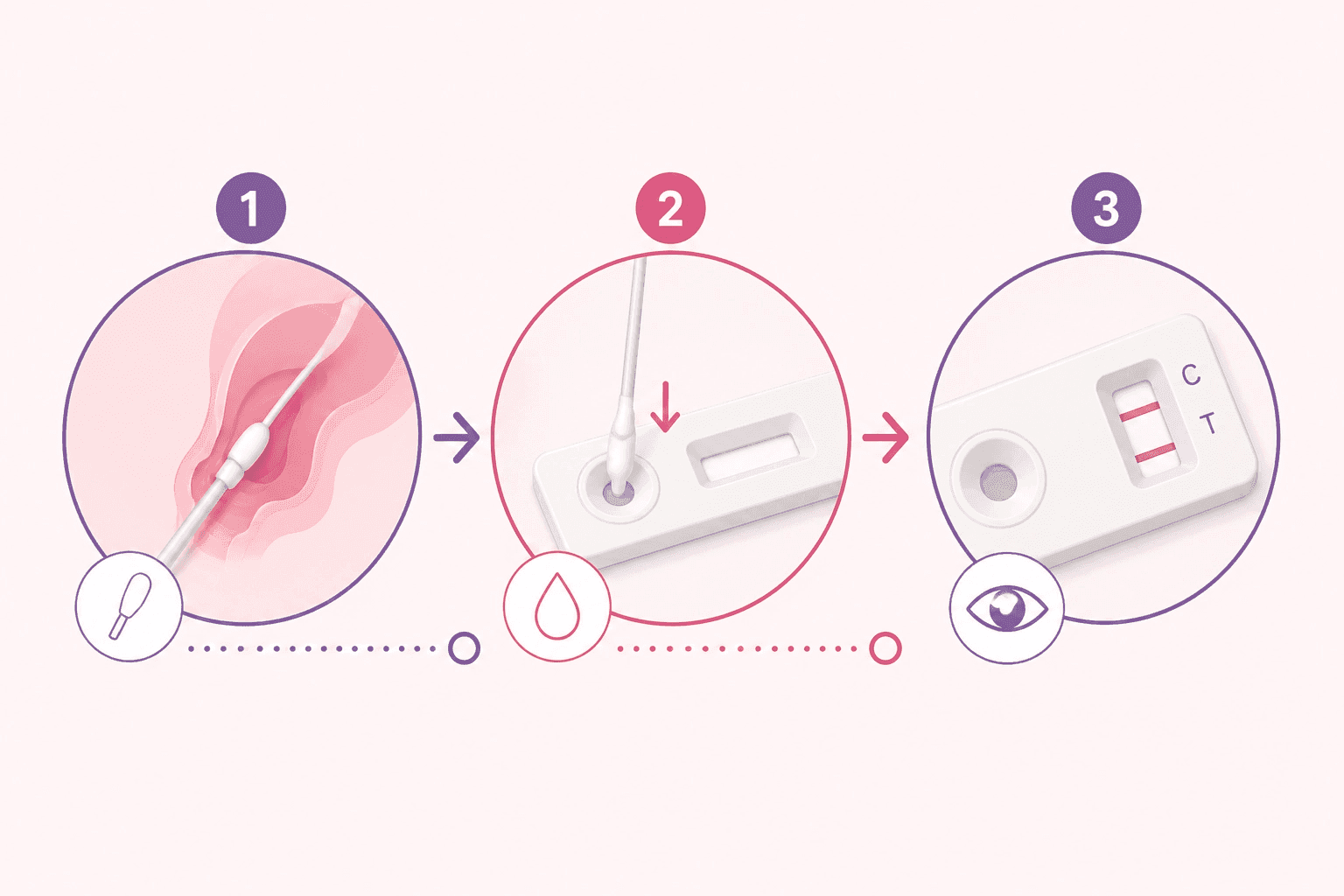
During the test
Remove the packaging from the swab or reactive strip
In a comfortable position (standing with one leg raised, sitting on the toilet, or lying down), gently insert the device into the vagina according to the manufacturer's instructions, generally 3 to 5 cm
Hold in place for the indicated time (generally 10 to 30 seconds)
Gently remove the device
After the test
The time varies depending on the type of test. A simple pH test gives a result in 30 seconds to 1 minute.
More comprehensive tests, such as those that simultaneously analyse pH, yeast, and other markers (e.g., Santelle), may require up to 10 minutes for the reaction to complete. Always consult your kit's leaflet.
Compare the colour or lines with the chart on the box
Note the time and result: beyond the reading time limit, the result is no longer reliable
Throw the used device in the bin (not down the toilet)
Interpreting the results of your thrush self-test
Reading the results of a self-test is not always intuitive; a colour slightly different from the guide, a faint line, and doubt sets in.
Here is how to interpret each scenario, to understand what your test is really telling you and know what to do next.
Result in favour of thrush
The pH is normal and/or the presence of yeast is detected. If you also experience itching, burning, or white, lumpy discharge, this picture is consistent with vaginal thrush.
You can consider an over-the-counter antifungal treatment (pessary + cream).
Result in favour of vaginosis
A high pH points towards bacterial vaginosis, an infection caused by an imbalance in vaginal flora, unrelated to a fungus.
An antifungal would be completely ineffective in this case and could even worsen the imbalance.
Consult a doctor or midwife: treatment is based on specific antibiotics, often prescribed as a vaginal gel.
Negative result but persistent symptoms
A negative result is not enough to rule out an infection: the sensitivity of yeast tests is not 100%, and other causes (irritation, allergy, trichomoniasis) can give similar symptoms.
If symptoms do not improve within 48 hours, do not delay in consulting; a vaginal swab will provide an accurate diagnosis.
Result difficult to read
An intermediate colour, a faint line, insufficient lighting—it happens.
Do not attempt to interpret an ambiguous result: repeat the test with a new kit, strictly following the instructions (reading time, lighting).
If doubt persists, your brand's app may help, or consult directly; an uncertain result is not worth treating at random.
What to do after a positive thrush test?
Treatments available over the counter
In the event of proven thrush, several local treatments are available in pharmacies without a prescription:
Antifungal pessaries (clotrimazole, miconazole, econazole): local treatment in 1, 3, or 6 days depending on the specific product
Antifungal creams to relieve vulvar symptoms (itching, redness)
Suitable intimate washes (acidic pH) to accompany the treatment without disrupting the flora
The most common treatments: Gynopevaryl, Monazol, Gyno-Pevaryl LP, Polygynax.
When to see a doctor?
If you have never had thrush, the first time always warrants a consultation: symptoms can resemble other infections (vaginosis, trichomoniasis) and incorrect treatment will only make matters worse.
Similarly, if you have started treatment and feel no improvement after 72 hours, do not wait any longer; it is a sign that further investigation is needed.
A consultation is necessary in the following situations:
First thrush infection: to confirm the diagnosis and establish a reference treatment
No improvement after 72 hours of treatment
Frequent recurrences (more than 4 episodes per year): recurrent thrush requires an assessment
Pregnancy: never treat yourself during pregnancy without medical advice
Unusual symptoms: fever, pelvic pain, foul-smelling discharge
How to prevent recurrences?
Many women experience thrush several times in their lives.
While antifungal treatment remains the curative response, there are daily habits that can help reduce the risk of it happening again.
Choose loose, cotton underwear; heat and moisture promote the proliferation of Candida.
Avoid douching and scented products: they disrupt the natural balance of the flora.
Dry the intimate area thoroughly after washing or exercising.
In case of predisposing factors (diabetes, sugary diet), limiting refined sugars can help rebalance the vaginal environment.
When taking antibiotics, consider taking probiotic supplements (lactobacilli), as antibiotics also destroy good bacteria.
These tips are preventive and complementary, not curative.
In case of recurring thrush, a medical consultation remains essential to rule out an underlying cause.
Frequently asked questions
Is a yeast infection self-test reliable?
Self-tests sold in pharmacies are CE-certified medical devices. pH tests are very reliable; yeast detection tests (anti-Candida antibodies) have a sensitivity of around 82 to 88%, with a risk of false negatives where the fungal load is low. They point towards a diagnosis, but do not replace a clinical examination where there is doubt or recurrence.
Can you do a self-test during your period?
No. Menstrual blood makes vaginal pH more alkaline (normally 3.8 to 4.5) and can skew both types of test. Wait 2 to 3 days after your period ends for a reliable result.
Can you do a yeast infection test while pregnant?
Yes, a self-test carries no risk during pregnancy. However, candidiasis is more frequent and more recurrent because of hormonal changes. Any treatment, including over-the-counter pessaries, must be approved by a doctor or midwife, as some antifungals are contraindicated depending on the trimester.
Does my partner need treatment too?
Not systematically. Candida albicans is not strictly an STI, but transmission is possible. Treating the partner is advisable if they have symptoms (balanitis: redness, itching, burning on the glans) or in cases of recurrent yeast infections (4 or more episodes a year). In the latter case, a fuller assessment is needed (diabetes, immunosuppression).
How much does a yeast infection self-test cost in a pharmacy?
Expect between €8 and €15 depending on the brand and the type (pH alone or combined with yeast detection). Combined pH and yeast kits generally cost between €12 and €15.
Can you combine a pH test and a yeast test?
Yes, and it is the best approach where there is doubt. A low pH with a positive yeast test means a yeast infection is likely. A high pH (above 4.5) points towards bacterial vaginosis or trichomoniasis, for which the treatment is different, and using an antifungal alone would be a therapeutic mistake.
Is reimbursement possible?
Self-tests are not covered by the French health system. Some complementary insurers reimburse part of the cost under their prevention cover, so check with yours. In cases of recurrent yeast infections, a medical consultation with a mycological swab can qualify for reimbursement.
Written by
Zineb Sadki
Editorial writing, Santelle
Zineb is a writer at Santelle and covers intimate health and the vaginal microbiome.