

Flora and Microbiota
Menopause test: what can vaginal pH reveal?

Zineb Sadki
Editorial writing, Santelle
Irregular cycles, hot flushes, vaginal dryness, disturbed sleep… As menopause approaches, the first signs can be numerous and sometimes difficult to link together.
So, is there a test you can do at home to find out if you are entering perimenopause or menopause?
The best-known self-tests measure FSH (follicle-stimulating hormone) in urine.
But the hormonal changes of this period also have direct effects on vaginal health, particularly on vaginal pH.
With the drop in oestrogen, the vaginal environment gradually becomes less acidic and the pH can increase.
Measuring your pH alone does not diagnose menopause, but it can provide an additional benchmark to better understand the changes occurring in the vagina.
In this article, we will look at what vaginal pH can actually reveal during perimenopause and menopause, how it differs from an FSH self-test, and in which cases tracking it can be useful.

Can you find out if you are entering menopause with a test?
Not with certainty using a self-test alone.
Perimenopause is the transition period that precedes menopause.
Hormones fluctuate and periods can become irregular for several months or several years.
Common signs include:
shorter, longer, or more widely spaced cycles;
hot flushes or night sweats;
sleep disturbances;
irritability or mood swings.
Menopause is considered established when a woman has not had a period for 12 consecutive months, in the absence of another cause.
Typically, its diagnosis is based primarily on age, menstrual cycle changes, and symptoms. Hormonal tests are generally not necessary to confirm menopause in a woman between 45 and 55 years old.
Self-tests should therefore be considered as orientation tools, and not as tests capable of making a diagnosis on their own.
What menopause tests are available?
At home, two indicators can be encountered: urinary FSH and vaginal pH.
They can both change with the hormonal shifts of menopause, but they do not measure the same thing at all.
FSH urinary self-test | Vaginal pH test | |
|---|---|---|
What it measures | FSH level in urine | Acidity of the vaginal environment |
What it reflects | Changes in the hormonal activity of the ovaries | Local effects of the drop in oestrogen on the vaginal environment |
How it is used | Strip or test performed with a urine sample | Test applied to the vaginal area |
Result | Elevated FSH or not depending on the test threshold | pH value or range |
Main limitation | FSH can fluctuate during perimenopause | pH can vary for reasons other than menopause |
Can it diagnose menopause? | No | No |
FSH self-test: a one-off hormonal indicator
As menopause approaches, the ovaries gradually become less sensitive to the hormones that regulate the cycle. The body may then produce more FSH in an attempt to stimulate their activity.
This is the phenomenon targeted by urinary menopause self-tests sold in pharmacies.
But during perimenopause, hormone levels can vary significantly from one moment to the next. An isolated result therefore does not allow you to determine exactly where you are in the transition.
Vaginal pH test: an indicator of local change
Vaginal pH answers a different question.
It does not measure a hormone. It allows you to observe how hormonal changes directly influence the vaginal environment.
This is why pH can be interesting when the first signs mainly affect the intimate area: dryness, vaginal irritation, discomfort during intercourse, or unusual vaginal changes.

Why does vaginal pH increase at menopause?
Before menopause, oestrogens indirectly contribute to maintaining an acidic vaginal environment.
They promote the presence of glycogen in the vaginal cells. This supports the development of lactobacilli, bacteria naturally present in the vaginal microbiota that are involved in producing lactic acid.
In simple terms:
less oestrogen → less glycogen → fewer lactobacilli → less lactic acid → higher vaginal pH.
In a woman during her reproductive years, vaginal pH is generally around 3.8 to 4.5.
With the decrease in oestrogen during and after menopause, the vagina gradually becomes less acidic. Studies have indeed observed an association between a higher vaginal pH and menopausal status.
What is the vaginal pH at menopause?
A pH above 4.5 can be observed when oestrogen levels decrease.
But this value should not be interpreted as a threshold to say: "my pH is over 4.5, therefore I am menopausal".
Vaginal pH is not specific to menopause.
A modification of the microbiota or certain vaginal infections can also alter the vaginal environment.
The result must therefore always be interpreted alongside symptoms, age, cycle changes, and the general context.
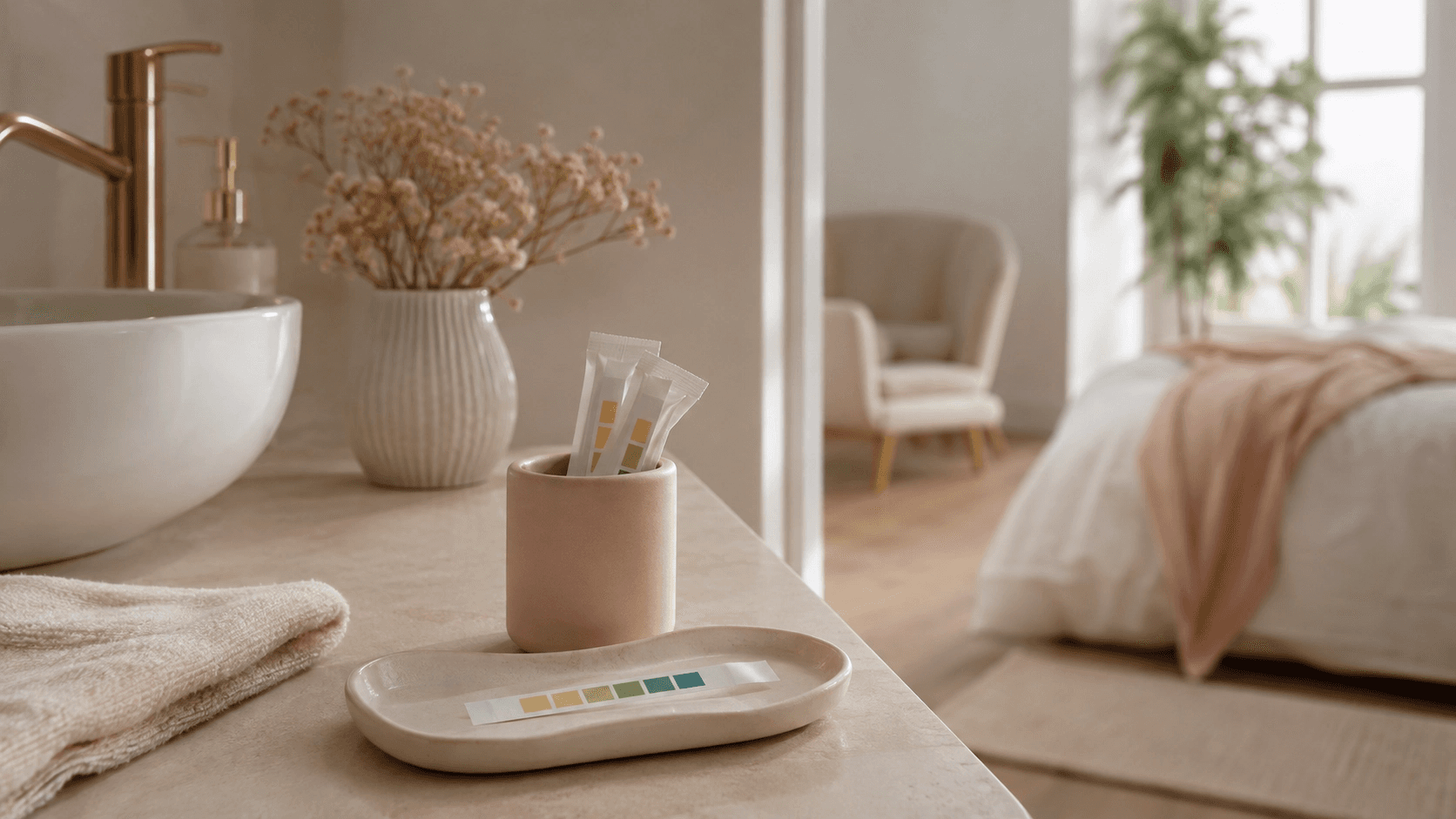
Does a high pH definitely mean you are in menopause?
No. This is probably the most important limitation to understand before using a vaginal test.
A high pH can be compatible with a drop in oestrogen, but it does not allow the cause to be determined on its own.
Conversely, having a pH within the usual values does not rule out perimenopause either.
The pH therefore provides information on the vaginal environment, and not a definitive answer to the question "am I menopausal?".
What vaginal changes can appear during menopause?
The drop in oestrogen does not only alter the pH.
It can gradually transform the tissues and microbiota of the vulvovaginal area.
This is particularly referred to as genitourinary syndrome of menopause when these changes cause vaginal, sexual, or urinary symptoms.
Among the possible symptoms:
persistent vaginal dryness;
burning sensation or irritation;
itching;
discomfort or pain during intercourse;
sensation of fragility or increased sensitivity;
urinary symptoms or repeated urinary tract infections.
Dryness, pain during intercourse, and certain urinary symptoms are part of the well-documented manifestations linked to the genitourinary changes of menopause.
These symptoms can appear gradually and do not necessarily occur all at the same time.
They are also not specific to menopause: irritation, an infection, or other vaginal problems can cause similar sensations.
FSH or vaginal pH: which test to choose?
It all depends on the question you are trying to answer.
If your main question is: "Could my cycle changes be linked to perimenopause?"
an FSH self-test can provide additional hormonal information, while keeping in mind that a one-off result remains difficult to interpret during this period of fluctuations.
If your question is rather: "Why does my vaginal health seem to be changing?"
vaginal pH may be more relevant, particularly in the presence of dryness, irritation, or other intimate changes.
The two tests are therefore not really competing.
FSH provides information on hormonal activity, while pH provides information on the vaginal environment.
And neither should be used in isolation to make a diagnosis of menopause.
Why track your vaginal pH during perimenopause?
The main interest of pH is to provide an additional benchmark on the progression of vaginal health.
A one-off result only gives a snapshot at a given moment.
Observing changes over time, in parallel with symptoms and cycles, can help to better identify a trend.
This tracking can particularly help you notice:
that dryness or discomfort appears at the same time as a change in pH;
that a vaginal change persists rather than remaining temporary;
that certain symptoms warrant discussion with a healthcare professional.
The goal is not to turn every variation into a sign of menopause, but to have more information to understand what is changing in your body.
What about a vaginal test like Santelle?
A vaginal test should not be presented as a diagnostic test for menopause.
Its value lies more in tracking vaginal health: it can provide information on the vaginal environment when intimate symptoms appear or evolve during perimenopause.
This distinction is important.
The question is not just: "Am I in menopause?"
but sometimes also: "Have hormonal changes started to alter my vaginal balance?"
In this context, monitoring your vaginal health can complement the observation of cycles and other symptoms, without replacing a medical consultation when one is necessary.
How to interpret a test result?
The result makes the most sense when placed in context.
Situation | What this may suggest |
|---|---|
Irregular cycles + hot flushes | Possible perimenopause |
Menopause symptoms + elevated FSH test | Compatible with a hormonal transition |
Elevated vaginal pH without other symptoms | Possible modification of the vaginal environment |
Elevated pH + unusual odour, discharge, or irritation | Another vaginal cause is possible |
Dryness or persistent pain | Possible genitourinary changes |
Significant symptoms or unusual bleeding | Require a medical evaluation |
When to consult?
It is not necessary to wait for a test to be "positive" to seek medical advice.
A consultation can be useful if:
symptoms become bothersome in daily life;
hot flushes or sleep disturbances are significant;
dryness or pain during intercourse persists;
urinary tract or vaginal infections are repeated;
unusual discharge, odour, or irritation appears;
you experience unusual bleeding;
you have doubts about the origin of your symptoms.
The healthcare professional will then be able to put the symptoms into context and determine if further tests are actually needed.
Conclusion
A self-test alone cannot confirm menopause.
Urinary FSH tests give an indication of hormonal changes, while vaginal pH provides information about changes occurring locally in the vagina.
With the drop in oestrogen, vaginal pH tends to increase, and certain symptoms like dryness, irritation, or pain during intercourse may appear.
The pH can therefore be a useful benchmark for monitoring vaginal health during perimenopause, but it must always be interpreted alongside other signs and not as a diagnosis.
Frequently asked questions
What test should I do to find out if I am in menopause?
There is no self-test capable of confirming menopause on its own. Self-tests sold in pharmacies generally measure FSH in urine. They can provide an indication of hormonal changes, but FSH levels fluctuate significantly during perimenopause. In a typical situation, the diagnosis of menopause is mainly based on age, symptoms, and the absence of periods for 12 consecutive months.
Are menopause tests sold in pharmacies reliable?
They can correctly measure the marker they were designed for, but this does not mean their result allows for a definitive diagnosis of menopause. The main difficulty lies in the interpretation: hormones can fluctuate during perimenopause, and a positive or negative result is not enough to accurately determine the stage of the transition.
What is the normal vaginal pH before menopause?
Before menopause, the vaginal pH is generally acidic, sitting around **3.8 to 4.5**. This acidity is notably linked to the presence of lactobacilli in the vaginal microbiota.
What is the difference between an FSH test and a vaginal test?
The FSH test measures a hormone in urine and provides information on the hormonal activity of the ovaries. A vaginal pH test measures the acidity of the vagina and provides information on changes in its local environment. They therefore do not measure the same phenomenon.
Can you be in perimenopause with a negative FSH test?
Yes. During perimenopause, hormones can fluctuate wildly. A single result therefore cannot rule out perimenopause if cycles and symptoms are changing.
Written by
Zineb Sadki
Editorial writing, Santelle
Zineb is a writer at Santelle and covers intimate health and the vaginal microbiome.